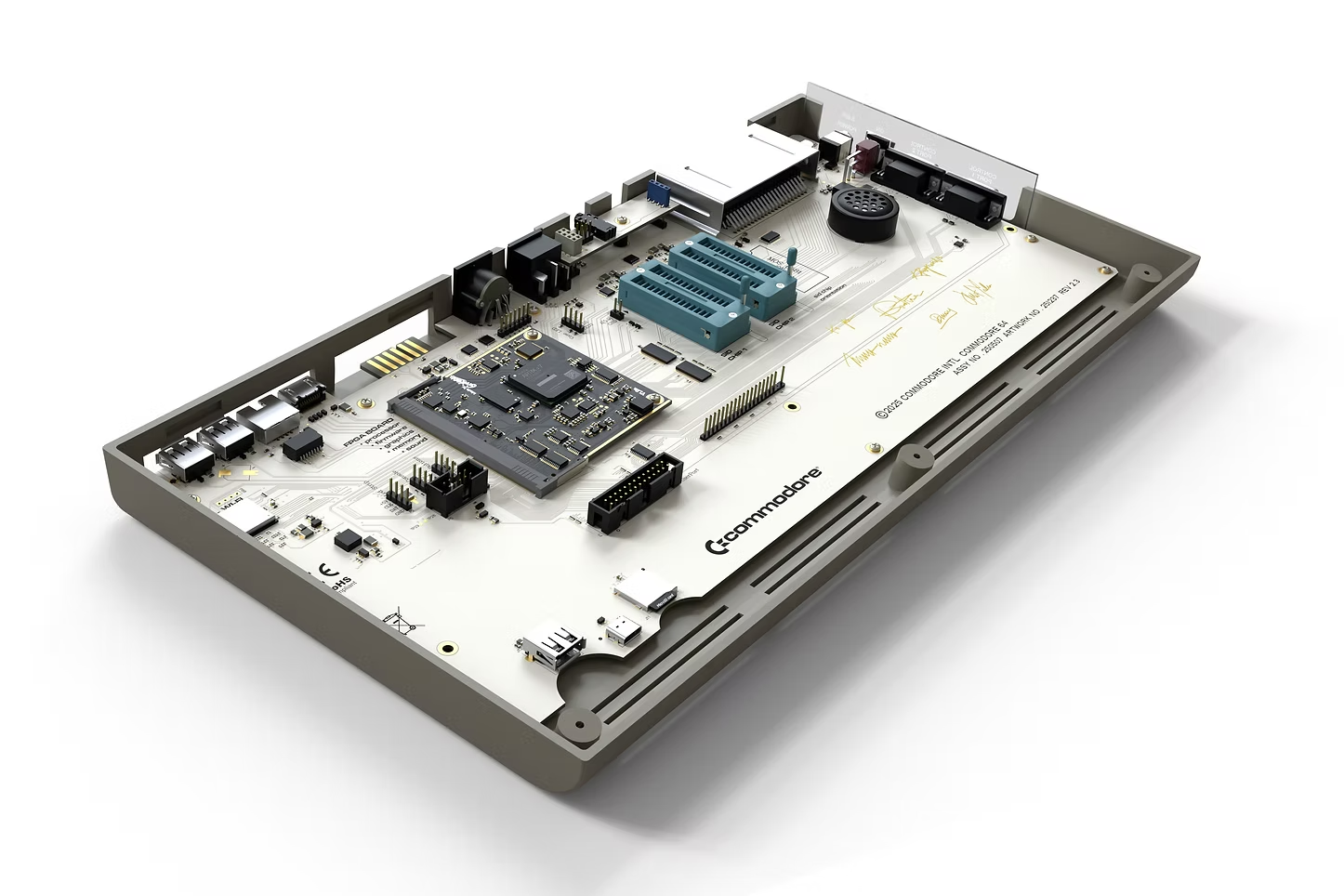
The Commodore 64 Ultimate is shaping up to be one of the most serious C64 revivals in decades — not because it simply looks like a breadbin, but because it tries to solve the real problem retro users face in 2026: we want authentic behavior and compatibility, but we also want modern usability without turning the machine into “just another emulator box”.
Two things are driving the hype right now: mainstream tech coverage calling it a top-tier revival, and Commodore’s own positioning of the C64U as “Not an emulator. Not a PC.” Instead, the device is described as being powered by an FPGA recreation of the original motherboard — which is exactly the kind of approach that tends to matter for timing, feel, and hardware-level compatibility.
Below is what stands out as genuinely new, genuinely useful, and what a buyer can realistically expect.
What’s new (and why it matters)
1) FPGA-based core: closer to “real hardware” behavior
Commodore.net explicitly states the C64 Ultimate is powered by an FPGA recreation of the original motherboard. In practical terms, this is the difference between “software pretending to be a C64” and “hardware configured to behave like a C64”. For users, that usually means:
- better cycle accuracy potential,
- more faithful edge cases,
- fewer “this demo/game breaks on my setup” moments.
For the scene, that’s the headline: an FPGA C64 platform can be a strong baseline for running classic productions and testing new ones.
2) Compatibility focus: “10,000+” games, cartridges, peripherals
Commodore.net claims compatibility with 10,000+ original retro games, cartridges, peripherals. That’s obviously a marketing number, but the intent is clear: the C64U is aiming at broad real-world usage, not a curated “top 50” library. If you’ve ever built a setup around original carts, joysticks, or oddball peripherals, you know why this matters.
3) More headroom: extra RAM + 48 MHz Turbo boost
One of the most interesting “new tricks” mentioned on commodore.net is more RAM plus a 48 MHz Turbo boost. That doesn’t rewrite what the C64 is, but it opens doors:
- faster loading/processing for certain workflows,
- more comfortable development/testing,
- potential new homebrew that targets “Ultimate-enhanced” modes while still respecting classic compatibility.
The key will be how cleanly users can switch between “pure classic” and “enhanced” behavior.
4) Modern connectivity: Wi‑Fi transfer (and the modern-output reality)
Commodore.net lists Wi‑Fi game transfer as a core feature. That’s huge for daily use: moving software onto a C64 setup has always been the friction point (disk images, adapters, SD solutions, etc.). Wi‑Fi transfer is basically Commodore acknowledging that convenience is what gets machines used instead of shelved.
PC Games Hardware also highlights modern upgrades like HDMI, Ethernet, and Wi‑Fi as barrier removers — the kind of features that make the C64U viable on modern desks, capture setups, and TVs.
5) Packaging + “physical culture” details
Commodore.net leans hard into the experience: spiral-bound manual, glossy classic box, and even creator autographs etched into the mainboard copper (1982 + 2025). That’s collector energy — but it’s also part of what makes a modern release feel like a real product, not a kit.
6) Visual identity: reactive LEDs, optional classic beige, transparent keyboard PCB
This is where the C64U goes full retro-futurism. Commodore.net mentions:
- color-changing case and keyboard LEDs that respond to SID (it references “2 real or 8 replicated onboard SID sound chips”),
- an option for classic beige,
- and the world’s first transparent keyboard circuit board.
Whether you love RGB or hate it, the important part is: it’s optional (at least by positioning), and the classic look is still respected. For some users, the transparent PCB is the real flex — hardware made visible, not hidden.
What’s good (the real advantages)
If Commodore delivers on the claims, the C64 Ultimate’s advantages are straightforward:
- Authentic-first architecture (FPGA motherboard recreation)
- High practical compatibility (software + carts + peripherals)
- Modern usability (Wi‑Fi transfer, modern outputs/networking)
- Optional enhancements (Turbo, extra RAM) without killing the classic core
- A complete “new machine” experience (manual, box, physical presentation)
In other words: it’s aiming to be a C64 you actually use daily — not just admire.
What to expect as a user
Expect a machine that tries to satisfy three audiences at once:
- Collectors who want a premium “new Commodore” experience
- Retro gamers who want frictionless play on modern displays
- Scene/dev users who care about behavior, compatibility, and a stable baseline
The big open question (for all of us) is how the C64U behaves in the real world with demanding demos, tricky loaders, and edge-case hardware. But as a feature set, it’s one of the most compelling “C64 in 2025/2026” concepts we’ve seen.
Leave a Reply